It's probably no secret that I'm a big fan of menswear illustration. So what a great surprise when I was followed on Twitter by Matthew Miller "Sunflowerman" and I began exploring his website and Tumblr. Here are a few favorite images from his Book Page Gallery.
Showing posts with label illustrated dandy. Show all posts
Wednesday, January 30, 2013
Thursday, October 18, 2012
Dandy Advertising
A 1920 Hart Schaffner Marx advertising, most likely by J.C. Leyendecker. Via The New York Public Library.
Tweet This
Tuesday, September 25, 2012
Saturday, August 18, 2012
Sunday, April 8, 2012
Sunday, November 27, 2011
Saturday, July 23, 2011
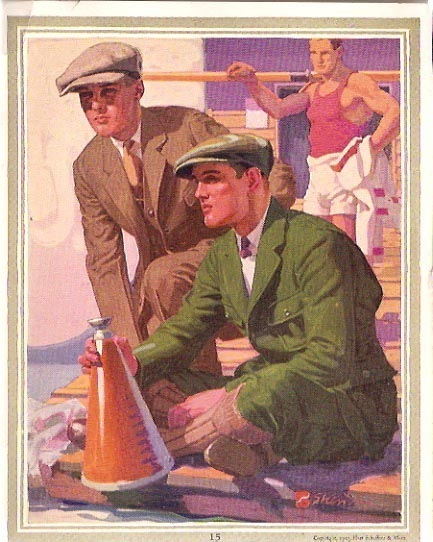
Illustrated Dandy
From the July 10, 1920 issue of Judge Magazine. This is how I envision an ideal way of spending a summer Saturday (if it wasn't for this brutal heat wave).
Tweet This
(click to enlarge)
Wednesday, July 13, 2011
Illustrated Dandy: Richard Haines
I've been meaning to post this sketch by my friend Richard Haines of Bruno Cucinelli at Pitti Uomo. The photos coming in last month from the biannual men's trade show in Florence were incredible but I think this image is my favorite. As Richard said, very Italian dandy, no?
Tweet This
Tuesday, March 15, 2011
Saturday, January 15, 2011
Illustrated Dandy: Hannah Exall
Our friend Hannah just shared a few images she's been working on. I see a new line of dandy greeting cards! Hallmark, are you reading this?
Tweet This
Monday, December 20, 2010
Saturday, November 13, 2010
Illustrated Dandy: Pour Voyager
From the October 1921 issue of Monsieur, reprinted in 100 Years Of Fashion Illustration. Love those tweedy patterns.
Saturday, August 28, 2010
Illustrated Dandy: Hannah Exall
Earlier in the year we posted some images from Hannah Exall, a student in the Textile Design for Fashion program at Manchester Metropolitan University in the UK. Here is some new work. We can imagine the first image as the wallpaper in our first brick and mortar store!
Tuesday, August 24, 2010
The Dapper Gents Of Al Hirschfeld's World
I've known Al Hirschfeld's work for many years as the illustrator for the The New York Times (mostly having covered the theatre). I just recently rediscovered his work and was struck by how he captured the style of the men he illustrated. Here are a few favorite images. By the way, did you know that Hirschfeld frequently hid his daughter's name (Nina) in his drawings and that a number next to his signature indicates the number of "Ninas" in that particular drawing?
Cafe Crown (Yiddish Theatre) 1942
Danny Kaye 1953
Odets Plays 1939
Nathanael West
Guys And Dolls 1950
Eugene O'Neill 1974
Sweet Bye And Bye (creative team) 1946
Franklin Delano Roosevelt 1930
Christopher Plummer 1997
The Entertainer (Laurence Olivier) 1958
images from Hirschfeld On Line.
C.H.
Monday, August 2, 2010
Illustrated Dandy: Richard Haines Portaits
Our friend Richard Haines is doing another $50 portrait special. Richard is a fashion illustrator and blogger (What I Saw Today) and has collaborated with the likes of J. Crew, 3Sixteen, Barneys, and Pennyblack. Check it out here and email Richard for more details.
C.H.
Wednesday, July 7, 2010
Guest Dandy: John E. Sheridan & The American Collegiate Ideal
Several weeks ago we were contacted by Richard Cellini who had discovered our post on the 1916 Hart Schaffner & Marx Style Book, and offered to buy it from us. Richard has been in the process of curating a collection of work of the illustrator John E. Sheridan to be donated to Georgetown University, of which both gentlemen share as their Alma Mater. Sheridan's illustrations were featured in our style book. We proposed a trade: We would provide the desired style book in exchange for a guest post featuring Sheridan's work.
John E. Sheridan (1880-1948) was a well-known American illustrator during the “Golden Age of Illustration” (1900-1950). As an artist and commercial illustrator, Sheridan was romantic and idealistic – a trait he shared with J.C Leyendecker, Edward Penfield, Samuel Nelson Abbott, and other major illustrators of the period. Sheridan spent his entire career painting and drawing idealized images of privileged, graceful and beautiful young men and women wearing costumes and engaging in social and sporting activities typical of the American upper-classes of early 20th century. Even Sheridan’s private sketchbook (from his days as an art student in Paris from 1920-23) demonstrates his nearly all-consuming interest in this subject.
Today, Sheridan is considered one of the originators of an aesthetic known as the “American collegiate ideal” -- an approach that still has resonance in commercial illustration and photography today (including images associated with GQ, Polo Ralph Lauren, Brooks Brothers, and Abercrombie & Fitch).
As a professional illustrator working primarily in New York City, Sheridan created more than 50 full-color cover illustrations for major periodicals of note, including: The Saturday Evening Post; The American Magazine; Collier’s; and The San Francisco Chronicle Sunday Supplement. In addition, he created richly illustrated advertisements for Edison Phonograph; Hart Schaffner & Marx; DuPont Automobiles; Chesterfield Cigarettes; and Bosch Magneto Corporation. In an era before television, color cinema, or the widespread use of color photography, John E. Sheridan helped supply the nation with an enduring image of youthful elegance and grace.
Sheridan was a 1901 graduate of Georgetown University in Washington, DC. While at Georgetown, Sheridan created a number of illustrations for various Georgetown publications, student societies, and events. Among other things, he drew a number of splendid posters for Georgetown athletic events and teams (primarily baseball, football, and track & field). His 1948 obituary in The New York Times credited Sheridan with "the idea of using posters to advertise college sports" (a distinction he must share with Bristow Adams and Edward Penfield). The Times also noted that Sheridan "was active during World War One in the making of patriotic posters, and was a member of the [WWI] artist's committee headed by Charles Dana Gibson."
Sheridan's collegiate posters are very distinctive, and much admired at Georgetown even to this day. Indeed, Sheridan is recognized as having created an ideal of the “Georgetown man” that still has great cultural power and force at the University more than 100 years after his graduation. Georgetown University’s Lauinger Library (Special Collections Division) is today recognized as possessing the largest and deepest collection of the works of John E. Sheridan.
Tweet This
John E. Sheridan (1880-1948) was a well-known American illustrator during the “Golden Age of Illustration” (1900-1950). As an artist and commercial illustrator, Sheridan was romantic and idealistic – a trait he shared with J.C Leyendecker, Edward Penfield, Samuel Nelson Abbott, and other major illustrators of the period. Sheridan spent his entire career painting and drawing idealized images of privileged, graceful and beautiful young men and women wearing costumes and engaging in social and sporting activities typical of the American upper-classes of early 20th century. Even Sheridan’s private sketchbook (from his days as an art student in Paris from 1920-23) demonstrates his nearly all-consuming interest in this subject.
Today, Sheridan is considered one of the originators of an aesthetic known as the “American collegiate ideal” -- an approach that still has resonance in commercial illustration and photography today (including images associated with GQ, Polo Ralph Lauren, Brooks Brothers, and Abercrombie & Fitch).
As a professional illustrator working primarily in New York City, Sheridan created more than 50 full-color cover illustrations for major periodicals of note, including: The Saturday Evening Post; The American Magazine; Collier’s; and The San Francisco Chronicle Sunday Supplement. In addition, he created richly illustrated advertisements for Edison Phonograph; Hart Schaffner & Marx; DuPont Automobiles; Chesterfield Cigarettes; and Bosch Magneto Corporation. In an era before television, color cinema, or the widespread use of color photography, John E. Sheridan helped supply the nation with an enduring image of youthful elegance and grace.
Sheridan was a 1901 graduate of Georgetown University in Washington, DC. While at Georgetown, Sheridan created a number of illustrations for various Georgetown publications, student societies, and events. Among other things, he drew a number of splendid posters for Georgetown athletic events and teams (primarily baseball, football, and track & field). His 1948 obituary in The New York Times credited Sheridan with "the idea of using posters to advertise college sports" (a distinction he must share with Bristow Adams and Edward Penfield). The Times also noted that Sheridan "was active during World War One in the making of patriotic posters, and was a member of the [WWI] artist's committee headed by Charles Dana Gibson."
Sheridan's collegiate posters are very distinctive, and much admired at Georgetown even to this day. Indeed, Sheridan is recognized as having created an ideal of the “Georgetown man” that still has great cultural power and force at the University more than 100 years after his graduation. Georgetown University’s Lauinger Library (Special Collections Division) is today recognized as possessing the largest and deepest collection of the works of John E. Sheridan.
From Sheridan’s private sketchbook:
Subscribe to:
Posts (Atom)